
In This Article
- 1. What Is the VMware Zero-Day Vulnerability?
- 2. How Long Were Hackers Exploiting the Flaw?
- 3. How ARMORY CASTLE Carried Out the Attack
- Initial access through BeyondTrust
- Moving through internal networks
- Exploiting VMware vCenter
- Maintaining access
- 4. Why Is This Vulnerability So Dangerous?
- 5. Who Is ARMORY CASTLE?
- 6. How Organisations Can Protect Their VMware Infrastructure
- Apply the latest security patches
- Restrict access to vCenter
- Monitor administrator accounts
- Check for existing compromise
- Strengthen network security
- 7. What This Attack Reveals About Modern Cyber Espionage
- Final Thoughts
- Sources and Further Reading
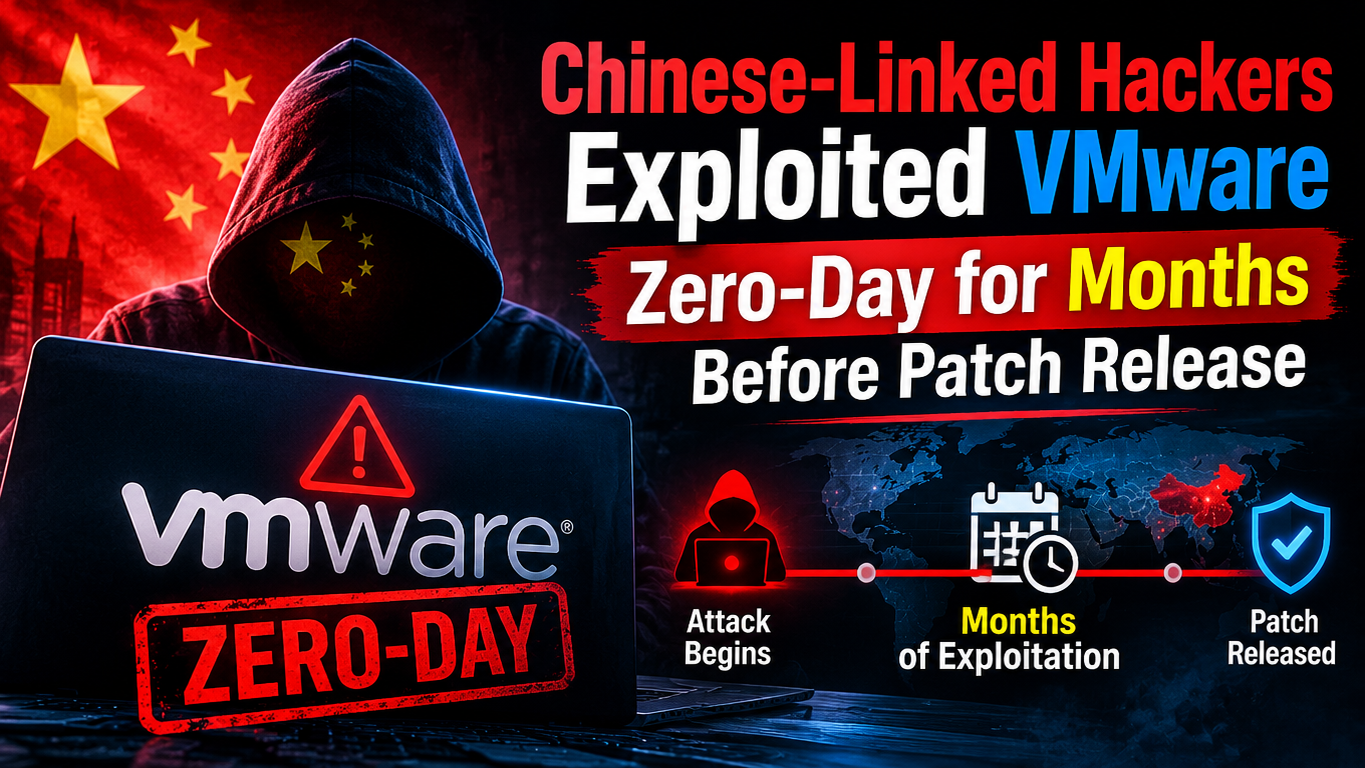
The VMware zero-day vulnerability CVE-2026-123890 has exposed a serious weakness in enterprise infrastructure after a suspected China-linked hacking group exploited the flaw months before its public disclosure. The attackers reportedly gained administrator-level access to VMware vCenter environments, potentially exposing sensitive information and critical virtual infrastructure.
According to Google Threat Intelligence Group (GTIG) and Mandiant, the threat actor known as ARMORY CASTLE, previously tracked as UNC5221, had been exploiting the vulnerability since early September 2026.
Broadcom publicly disclosed the security issue on November 19, 2026, assigning it a critical CVSS severity score of 9.8 out of 10.
The incident highlights how attackers are increasingly targeting the infrastructure that organisations depend on, rather than simply compromising individual computers or user accounts.
1. What Is the VMware Zero-Day Vulnerability?
The VMware zero-day vulnerability affects VMware vCenter Server, a central management platform used by organisations to manage virtual machines and ESXi host environments.
In simple terms, vCenter acts as a control centre for virtual infrastructure. Administrators use it to manage virtual machines, monitor resources, configure systems, and control different parts of their IT environment.
The vulnerability, identified as CVE-2026-123890, exists in the VMware Directory Service and involves a weakness in its Secure Remote Password (SRP) authentication mechanism.
According to Mandiant’s investigation, attackers exploited predictable UUIDv1 timestamp generation to obtain information that could be used to bypass the normal authentication process.
Successful exploitation could allow an unauthenticated attacker with network access to establish an authenticated session as:
administrator@vsphere.local
This is particularly dangerous because attackers may obtain administrator-level access without knowing the legitimate administrator’s password.
The vulnerability received a CVSS score of 9.8, placing it in the critical severity category.
2. How Long Were Hackers Exploiting the Flaw?
One of the most concerning aspects of this VMware zero-day vulnerability is the amount of time it remained unknown to the public while attackers were actively exploiting it.
According to Google Threat Intelligence Group and Mandiant, ARMORY CASTLE had exploited the flaw since early September 2026.
The vulnerability was publicly disclosed by Broadcom on November 19, 2026.
This means attackers had an opportunity to exploit affected environments before organisations could respond to a publicly available security advisory.
The investigation also connected this activity to an earlier campaign involving CVE-2026-102764, a critical vulnerability affecting BeyondTrust Remote Support.
The use of multiple vulnerabilities suggests that the operation involved careful preparation and a broader strategy for compromising enterprise networks.
3. How ARMORY CASTLE Carried Out the Attack
Mandiant’s investigation revealed a multi-stage operation involving compromised devices, network reconnaissance, authentication bypass, and specialised malware.
Initial access through BeyondTrust
The attackers initially exploited CVE-2026-102764, affecting BeyondTrust Remote Support appliances.
This vulnerability allowed unauthorised file operations on affected systems.
BeyondTrust Remote Support is commonly used by IT teams to access and troubleshoot systems remotely. A compromise of such infrastructure can provide attackers with an entry point into an organisation’s network.
Moving through internal networks
After gaining initial access, the attackers conducted reconnaissance to identify systems and services within the compromised environment.
They moved through Linux-based appliances, escalated privileges, and established additional footholds.
This allowed them to continue operating within the network while preparing to target more valuable infrastructure.
Exploiting VMware vCenter
The attackers subsequently exploited the VMware zero-day vulnerability using a specialised Go-based tool named BONESAW.
Mandiant identified BONESAW as a utility developed to exploit CVE-2026-123890.
The tool was used to obtain unauthorised access to vCenter, extract directory information, manipulate authentication mechanisms, and create administrator-level access.
Maintaining access
The attackers also deployed additional tools to maintain their presence and continue operating within compromised environments.
The investigation identified several malware families and utilities associated with the campaign.
These included:
- BONESAW: A remote exploitation utility targeting VMware vCenter.
- BEARBONES: A backdoor based on the Dropbear SSH server.
- SAWSNAKE: A tool used to manipulate VMware authentication mechanisms.
- SLIMSAVAGE: A webshell identified in the compromised environment.
- CAGEMATCH: Another webshell associated with the campaign.
- LAZYBONES: A backdoor that uses Slack for command-and-control communication.
The range of specialised tools demonstrates the attackers’ ability to adapt their techniques to different parts of an enterprise environment.
4. Why Is This Vulnerability So Dangerous?
A compromised personal computer can expose individual files, accounts, or credentials.
A compromised virtualisation management platform can create a much larger problem.
VMware vCenter manages virtual infrastructure used by organisations to operate applications, databases, business services, and internal systems.
If attackers obtain administrator-level access to this platform, they may gain opportunities to interact with multiple connected systems.
The potential consequences include:
- Unauthorised access to sensitive organisational information.
- Theft of credentials and authentication data.
- Creation of fraudulent administrator accounts.
- Movement between connected systems.
- Installation of persistent backdoors.
- Disruption of business operations.
- Further cyber espionage activities.
This is why the VMware zero-day vulnerability is particularly concerning for organisations that depend heavily on virtual infrastructure.
Instead of attacking every machine individually, a threat actor who compromises a central management platform may gain access to a much wider environment.
5. Who Is ARMORY CASTLE?
ARMORY CASTLE is a suspected China-linked cyber espionage group previously tracked as UNC5221.
Google Threat Intelligence Group and Mandiant have associated the group with attacks against enterprise infrastructure and security products.
Its activities have included exploiting previously unknown vulnerabilities in systems that provide remote access and administrative capabilities.
The latest investigation provides further evidence of the group’s technical capabilities, including its use of specialised exploitation tools and multiple malware families.
Google describes the group as a suspected PRC-nexus threat actor.
It is important to understand that threat intelligence attribution is an assessment based on available evidence. It does not independently establish that a particular government directed an operation.
6. How Organisations Can Protect Their VMware Infrastructure
Broadcom released security updates on November 19, 2026, addressing CVE-2026-123890.
Organisations using affected VMware products should review the official security advisory and apply the relevant fixes as soon as possible.
Here are five important security measures:
Apply the latest security patches
Administrators should identify affected VMware versions and install the appropriate security updates.
Broadcom’s advisory lists fixed versions for different product releases. Organisations should follow the relevant response matrix rather than assuming one update applies to every environment.
Restrict access to vCenter
The vCenter management interface should not be unnecessarily exposed to the public internet.
Access should be restricted to authorised administrative systems and trusted network segments.
Monitor administrator accounts
Unexpected administrator accounts, unusual authentication activity, and suspicious changes to VMware configurations should be investigated.
Check for existing compromise
Installing a patch does not automatically remove attackers who may already have gained access.
Organisations should review authentication logs, administrator accounts, system configurations, and other potential indicators of compromise.
Strengthen network security
Network segmentation, restricted administrative access, centralised logging, and continuous monitoring can make it harder for attackers to move between systems after compromising one device.
7. What This Attack Reveals About Modern Cyber Espionage
The VMware zero-day vulnerability is another example of how advanced threat actors exploit security weaknesses before vendors can release fixes.
Zero-day attacks are particularly difficult to defend against because organisations may have no publicly available patch when exploitation begins.
However, this incident also highlights another important issue: attackers do not always need to compromise every system individually.
A vulnerable remote access appliance can become an entry point into a larger network. From there, attackers may use compromised credentials, legitimate administrative tools, and specialised malware to reach more valuable infrastructure.
For organisations, this means cybersecurity cannot depend entirely on antivirus software or routine updates.
Protecting critical infrastructure requires visibility across networks, strong access controls, effective monitoring, and a clear understanding of how systems are connected.
Final Thoughts
The VMware zero-day vulnerability incident is a reminder that some of the most serious cyberattacks happen behind the scenes.
A weakness in a central management platform can expose an organisation’s wider digital infrastructure, potentially creating opportunities for espionage, data theft, and long-term unauthorised access.
What makes the ARMORY CASTLE campaign particularly concerning is the combination of multiple vulnerabilities, specialised malware, internal network movement, and exploitation before public disclosure.
The incident raises an important question for organisations: how secure is the infrastructure controlling everything else?
As cyber espionage becomes increasingly sophisticated, protecting the systems behind everyday digital operations is just as important as protecting the devices people use.
In the digital world, the biggest threat may not be the system you use every day, but the system controlling it.
Sources and Further Reading
- Google Threat Intelligence Group – ARMORY CASTLE Exploits vSphere (November 19, 2026)
- Broadcom – Official VMware Security Advisory VMSA-2026-0009
- BeyondTrust – Security Advisory BT26-05
- Google Threat Intelligence Group – Earlier ARMORY CASTLE Investigation
Editorial note: This article is based on publicly available vendor disclosures and cybersecurity research as of November 22, 2026. Threat actor attribution reflects the assessment of the cited security researchers.

Leave a Reply