
In This Article
- 1. What Is AI Voice Cloning?
- 2. How Criminals Use AI Voice Cloning to Steal Money
- 3. The CEO Fraud: When Hackers Impersonate Company Executives
- 4. Real-World Incidents Show the Scale of the Threat
- The Hong Kong deepfake video conference fraud
- AI voice cloning products and weak safeguards
- AI-powered scams in India
- 5. Why AI-Generated Voices Are Becoming Difficult to Identify
- 6. How an AI Voice Cloning Scam Works
- 7. How to Protect Yourself From AI Voice Cloning Scams
- Establish a family verification code
- Disconnect and call back
- Ask questions that require context
- Never transfer money under pressure
- Limit publicly available voice recordings
- Use additional verification at work
- 8. What Should You Do If You Become a Victim?
- 9. The Future of Voice-Based Identity Verification
- Conclusion: Never Trust a Voice Alone
Artificial intelligence has made it possible to recreate someone’s voice using a relatively short audio recording. What was once an advanced technology requiring specialised equipment can now be accessed through commercially available AI tools.
While voice cloning has legitimate applications in entertainment, accessibility, dubbing, and content creation, cybercriminals are increasingly exploiting the technology to impersonate real people.
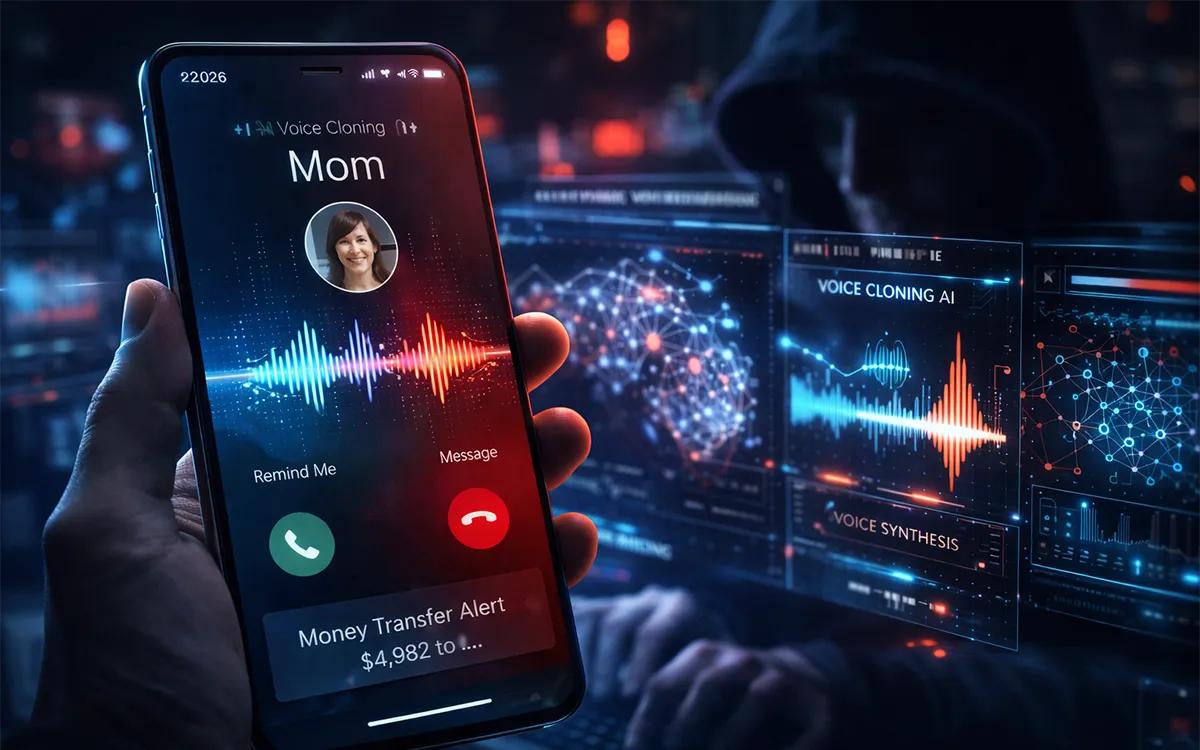
Imagine receiving a phone call from your brother, mother, or close friend. Their voice sounds familiar. They appear frightened and urgently request money because they are supposedly in trouble.
You recognise their voice and believe the situation is genuine.
But there is one problem: the person speaking may not be who you think they are.
AI-powered voice cloning is changing the way impersonation scams operate. Criminals can use synthetic audio to imitate family members, company executives, public figures, and other trusted individuals, making traditional methods of identifying fraudulent calls less reliable.
1. What Is AI Voice Cloning?
AI voice cloning is a technology that uses machine learning to reproduce the characteristics of a person’s voice.
A voice model can learn distinctive features such as:
- Tone and pitch
- Pronunciation and accent
- Speaking speed
- Vocal patterns
- Intonation and rhythm
Once trained, the model can generate artificial speech that resembles the original speaker.
Some modern services can produce convincing voice replicas using relatively short audio samples. These samples may come from public interviews, YouTube videos, Instagram reels, podcasts, or other online recordings.
This creates a significant security problem: people do not necessarily need to provide their voice recordings directly to criminals for their voices to be imitated.
2. How Criminals Use AI Voice Cloning to Steal Money
One of the most concerning applications of this technology is the impersonation of family members.
The scam often begins with information gathering.
Criminals may identify potential victims through social media, leaked information, public profiles, and other online sources. They then use publicly available recordings to create a synthetic voice resembling someone close to the target.
The attacker contacts the victim and creates an emergency.
Common scenarios include:
The accident scam: A caller impersonating a family member claims to have been involved in an accident and urgently needs money.
The kidnapping scam: Criminals pretend to have kidnapped a relative and use an AI-generated voice to make the threat more convincing.
The emergency hospital scam: A person impersonating a son, daughter, or parent claims they are in hospital and need immediate financial assistance.
The friend-in-need scam: An attacker impersonates a friend and requests money because of an alleged financial emergency.
The psychological manipulation is often more important than the technology itself. Criminals deliberately create panic and urgency so victims do not have time to verify the request.
3. The CEO Fraud: When Hackers Impersonate Company Executives
AI voice cloning is not limited to family-related scams. Businesses are also vulnerable.
This technique is commonly associated with Business Email Compromise (BEC) and CEO fraud.
In a typical attack, a criminal impersonates a company’s senior executive and contacts an employee responsible for financial transactions.
The caller may request an urgent payment to a supplier, provide new bank details, or instruct an employee to transfer money to an unfamiliar account.
Because the voice resembles someone with authority, the employee may follow the instructions without performing additional verification.
The risk is especially serious when organisations rely on voice recognition or informal telephone instructions for approving financial transactions.
A familiar voice should never be treated as sufficient proof of identity.
4. Real-World Incidents Show the Scale of the Threat
AI voice impersonation is not simply a theoretical cybersecurity concern.
The Hong Kong deepfake video conference fraud
In 2024, a finance employee at a multinational company in Hong Kong was tricked into transferring approximately US$25 million.
The attackers used deepfake technology to impersonate senior company executives during a video conference. The employee believed the participants were genuine and authorised the transfers.
The incident demonstrated how synthetic identities can be used to manipulate business processes and financial decisions.
AI voice cloning products and weak safeguards
A March 2025 investigation by Consumer Reports assessed voice-cloning products from six companies.
Researchers found that four of the six products they tested allowed the creation of voice clones from publicly available audio without meaningful technical verification of the original speaker’s consent.
This highlights a major challenge: technologies designed for legitimate voice generation can also be misused for impersonation and fraud.
AI-powered scams in India
India is also facing the wider risks associated with synthetic media.
A Moneycontrol investigation published in October 2026 documented how criminals in India are exploiting AI-generated voices, deepfake videos, and fabricated content for impersonation, extortion, and other forms of fraud.
These developments demonstrate why AI-enabled social engineering deserves greater attention from Indian internet users.
5. Why AI-Generated Voices Are Becoming Difficult to Identify
Traditional scam calls often contain noticeable warning signs, such as unnatural speech, poor audio quality, or suspicious requests.
Modern voice-generation systems can reproduce many of the characteristics people traditionally use to recognise familiar voices.
A scientific study published in Scientific Reports examined people’s ability to distinguish AI-generated voices from genuine recordings.
The researchers found that human listeners were not consistently reliable at identifying synthetic voices.
The study also suggested that longer, more natural conversations may help listeners identify suspicious interactions, although this is not a dependable detection method.
There is another important issue: attackers do not necessarily need a perfect voice replica.
If a victim is frightened, distracted, or under pressure, even an imperfect imitation may be convincing enough to trigger a payment.
6. How an AI Voice Cloning Scam Works
A typical attack can be divided into five stages.
Stage 1: Information gathering
The attacker identifies a potential victim and collects publicly available recordings of someone they know.
Stage 2: Voice replication
An AI voice-generation system is used to produce synthetic speech resembling the target person.
Stage 3: Impersonation
The criminal contacts the victim through a telephone call or messaging application.
Stage 4: Psychological manipulation
The attacker creates an emergency, demands secrecy, or pressures the victim to act immediately.
Stage 5: Financial exploitation
The victim is instructed to transfer money, disclose sensitive information, or share authentication codes.
The entire attack relies on combining technology with social engineering.
7. How to Protect Yourself From AI Voice Cloning Scams
There is no need to panic every time someone calls you. However, it is important to change how you verify urgent requests.
Here are some practical precautions.
Establish a family verification code
Agree on a private code word with close family members.
If someone calls claiming to be in an emergency, ask for the agreed code before sending money.
Do not share this code publicly or through social media.
Disconnect and call back
If someone requests money urgently, end the call.
Call the actual person using a phone number already saved in your contacts. Do not rely on a number provided by the caller.
Ask questions that require context
Ask questions about recent events, shared experiences, or information that an impersonator would not easily know.
However, do not treat correct answers as definitive proof of identity.
Never transfer money under pressure
Scammers deliberately create urgency to prevent victims from thinking clearly.
Verify every unusual financial request independently, even when it appears to come from a trusted person.
Limit publicly available voice recordings
Avoid unnecessarily sharing personal recordings and sensitive information publicly.
This does not guarantee protection, but reducing exposed personal information can make targeted impersonation more difficult.
Use additional verification at work
Businesses should require independent approval for high-value transfers and changes to supplier bank details.
A telephone call or voice message should never be the only authorisation mechanism for financial transactions.
8. What Should You Do If You Become a Victim?
If you suspect that you have been targeted by an AI voice cloning scam:
- Stop communicating with the suspicious caller.
- Contact the person being impersonated through a trusted number.
- Immediately contact your bank if money has been transferred.
- Preserve call logs, messages, screenshots, transaction references, and other evidence.
- Report the incident to the appropriate cybercrime authorities.
For victims in India:
- Call the national cybercrime helpline at 1930 as soon as possible if you have suffered financial cyber fraud.
- Submit a complaint through the official National Cyber Crime Reporting Portal.
- Contact your bank immediately to report the fraudulent transaction.
Quick reporting can improve the chances of intervention, although recovery of transferred money is not guaranteed.
9. The Future of Voice-Based Identity Verification
The increasing availability of AI voice-generation tools raises questions about the reliability of voice-based authentication.
Banks, businesses, customer-support services, and digital platforms have traditionally used voice as one way to recognise or verify individuals.
However, a voice that sounds authentic is no longer sufficient evidence that the speaker is genuine.
Security systems will increasingly need to combine multiple verification methods, including device-based authentication, independent approval procedures, anti-spoofing technology, and multifactor authentication.
Researchers are also exploring techniques such as synthetic-audio detection and digital watermarking. However, these methods are not universal solutions, and detection systems can struggle when confronted with unfamiliar or manipulated audio.
Conclusion: Never Trust a Voice Alone
AI voice cloning is changing the economics of online fraud.
Criminals no longer need to rely exclusively on poorly written messages, suspicious emails, or obvious impersonation attempts. They can exploit something much more personal: the human ability to recognise and trust familiar voices.
The technology itself is not inherently malicious. Its legitimate applications are valuable, but weak safeguards and criminal misuse create significant risks.
As synthetic voices become increasingly convincing, the responsibility to verify identity becomes more important than ever.
The next time someone calls you claiming to be a loved one in trouble, remember one thing: recognising a voice is not the same as verifying a person.
About this article: InfoWar examines emerging cybersecurity threats, digital manipulation, online fraud, and the technologies shaping modern cybercrime. This article is intended for cybersecurity awareness and educational purposes.

Leave a Reply